Sustainable Energy Storage Devices
Dr. Ali Shaygan Nia
In this group, we develop sustainable energy storage devices by designing novel electrode and electrolyte materials and interfaces, guided by three main principles.
- Avoiding the use of critical raw materials
- Utilizing aqueous -based electrolytes
- Designing systems based on multivalent metal ions, such as zinc ion
Our research focuses on two key application areas where safe and sustainable technologies are essential: printed electronics and stationary energy storage. To meet the performance requirements of these applications, we begin by developing new materials and formulations for electrodes, electrolytes, and interfaces. Building on these foundations, we design and fabricate energy storage devices in various formats, including printed, pouch, and prismatic cells.
Research Area I: Printed Energy Storage Devices
I-1. Printed Electrodes based on 2D materials inks/pastes
Two-dimensional (2D) materials have attracted significant attention for energy storage applications because of their unique structural and electronic properties. They can be used either directly as active electrode materials or as functional additives in electrode formulations to enhance conductivity, mechanical stability, and electrochemical performance. Despite their potential, the widespread adoption of 2D materials is still limited by the lack of scalable and cost-effective methods for producing high-quality materials with controlled thickness, lateral size, and defect density. Overcoming these challenges is essential for enabling their integration into next-generation energy storage devices.
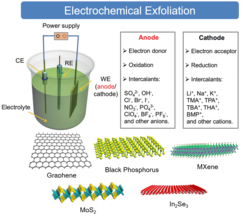
In this regard, electrochemical exfoliation of layered materials offers high yield, excellent efficiency, simple instrumentation, and up‐scalability, therefore it represents a key technology to advancing fundamental studies and industrial applications. Moreover, the solution processability of developed 2D materials by electrochemical exfoliation enables the fabrication of energy storage devices via different printing technologies such as inkjet, screen and 3D printing. Therefore, in our department, we explore the controlled electrochemical exfoliation process by intercalation of ions/molecules within layered crystals, fundamental physical/chemical properties as well as applications of emerging 2D materials such as black phosphorous, MXene, semi metals and transition metal dichalcogenides (Figure 2). We also aim to establish robust electro-chemical exfoliation methodologies for the in-situ functionalization, enabling the enhanced functionality of 2D materials and their processability via printing technologies.
I-2. Printed Electrolytes
Conventional liquid electrolytes often face challenges such as leakage, flammability, or incompatibility with thin and flexible device architectures, while solid-state electrolytes typically suffer from processing difficulties and limited interfacial contact.
To address these limitations, our research focuses on the development of printable aqueous electrolytes and polymer–gel systems that ensure safety, sustainability, and adaptability to various printing technologies. We investigate advanced electrolyte concepts, such as hybrid aqueous systems, polymer-based ion conductors, and redox-active electrolytes, to enhance energy density and cycling stability. Our aim is to establish electrolyte formulations that not only enable high-performance zinc-based batteries and supercapacitors but also support their seamless integration into fully printed and flexible electronic platforms.
Research Area II: Sustainable Batteries for Stationary Energy Storage
In our group, we focus on the development of sustainable batteries tailored for stationary energy storage. Our research emphasizes aqueous-electrolyte-based zinc batteries and dual-ion battery systems, which offer inherently safer chemistries and improved sustainability compared to conventional LIBs. We investigate novel electrode and electrolyte materials, optimize cell designs, and explore scalable fabrication approaches to achieve high performance, long cycle life, and environmentally responsible energy storage solution
II.1 Aqueous Zinc ion batteries
Aqueous zinc-ion batteries (AZIBs) are emerging as a promising technology for stationary energy storage due to their intrinsic safety, low cost, and environmental friendliness. In these systems, the choice and design of cell components, including the anode, cathode, and electrolyte, are critical for achieving high performance and long-term stability. Research in the field has shown that novel electrode materials for reversible zinc ion intercalation, as well as developing electrolytes that suppress dendrite formation and parasitic side reactions, is essential to improve energy density, cycle life, and operational reliability.
In our group, we focus on the development of novel electrode and electrolyte materials and the engineering of electrode–electrolyte interfaces (Figure 3). By tailoring the chemical composition, structure, and interactions within the cell components, we aim to enhance both the electrochemical performance and stability of zinc-ion batteries, enabling their practical application in stationary energy storage systems.
- Electrolyte
Electrolytes are central to the performance, safety, and longevity of aqueous zinc-ion batteries (AZIBs). In our group, we design advanced aqueous electrolyte formulations to tailor the Zn²⁺ solvation environment and thereby regulate the fundamental electrochemical processes at the electrode–electrolyte interfaces. By manipulating the coordination chemistry of Zn²⁺ through suitable salt combinations, additives, and solvent engineering, we aim to suppress side reactions such as hydrogen evolution and corrosion while enabling reversible Zn plating/stripping. In particular, we investigate electrolyte additives that induce the in-situ formation of robust solid–electrolyte interphase (SEI) layers on the zinc anode surface. These hybrid interphases, combining organic and inorganic components, are expected to homogenize Zn²⁺ flux, reduce interfacial resistance, and extend cycle life.
- Zinc anode interfaces
The zinc anode is the cornerstone of AZIBs, yet its practical deployment is hindered by dendrite formation, surface passivation, and parasitic reactions. Our research focuses on interface engineering strategies to overcome these limitations. We develop protective coatings—including metal–organic frameworks (MOFs), covalent organic frameworks (COFs), polymers, and inorganic thin films—to stabilize the Zn surface and modulate ion transport. Alloying strategies are also explored to enhance Zn deposition reversibility and mechanical robustness. In addition, we design structured zinc electrodes, such as porous Zn foams and zinc powder-based anodes, to optimize surface area utilization and buffer local ion concentration fluctuations. By combining these approaches, we aim to realize dendrite-free Zn anodes with high reversibility and long-term cycling stability.
- New emerging cathode materials and their interfaces
On the cathode side, our efforts are directed towards the development of advanced materials that deliver both high capacity and structural stability. We focus on manganese-based and vanadium-based cathodes, where doping and defect engineering are employed to enhance electronic conductivity, optimize ion diffusion pathways, and mitigate dissolution during cycling. In parallel, we investigate conversion-type cathodes, particularly halogen-based materials, which offer high theoretical capacities but require innovative strategies to address shuttle effects and sluggish reaction kinetics. By tailoring the composition, morphology, and interface chemistry of these cathode materials, we aim to unlock high energy density and durable performance for AZIBs, thereby advancing their application in large-scale stationary energy storage.
II.2 Dual ion batteries
Dual-ion batteries (DIBs) are an emerging battery technology based on anion-hosting cathode materials, such as graphite, and do not rely on traditional transition metals like cobalt, nickel, or manganese, giving them a transition metal-free characteristic. Unlike conventional lithium-ion batteries (LIBs), DIBs operate through the simultaneous participation of both cations and anions from the electrolyte in the charge and discharge processes. In this system, the electrolyte itself acts as an active material: anions are stored and released in the cathode, while cations are stored and released in the anode during charging and discharging, respectively (Figure 4).
In our group, we focus on developing concentrated electrolyte formulations and engineering artificial electrode-electrolyte interfaces to enhance the energy density and cycling stability of dual-ion batteries.
II.2.1. Concentrated electrolyte formulations
One key feature of dual-ion batteries is the concentration of the electrolyte. In DIBs, the electrolyte salt acts as the primary active component, and its concentration plays a critical role in determining the energy content of the battery. At concentrations above five molar, DIBs can achieve energy densities comparable to those of commercial lithium-ion batteries. Moreover, DIBs with electrolyte concentrations higher than six molar could offer lower costs per kilowatt-hour than lithium iron phosphate batteries. Consequently, one of our group’s main research activities is focused on the development of concentrated electrolytes to enhance the performance and economic viability of dual-ion batteries.
II.2.2. Artificial electrode-electrolyte interfaces
Anion intercalation into graphite layers in dual-ion batteries can lead to structural degradation of the graphite and reduce cycle stability. To address this challenge, our group develops ultrathin two-dimensional organic crystal-based artificial interfaces to regulate anion intercalation and improve the durability of the batteries. In addition, these 2D organic crystals form a conformal coating on the graphite electrode, which effectively stabilizes the electrolyte and further enhances the overall performance of the battery.